Intermediate Hair in Sugaring: How to Identify and Treat It with Confidence

Understanding Intermediate Hair:
The Hidden Challenge in Your Treatment Room
Have you ever noticed during a hair removal treatment that it just doesn’t feel like you got it all, and you can’t even see it? Yet when you check the skin surface with your wrist, it feels prickly.
You probably did everything right, but the skin still feels slightly prickly, and those clear, stubborn hairs seem to resist removal. What you’re dealing with isn’t poor technique, or a problem with product, it’s intermediate hair.
Intermediate hair is one of the most misunderstood stages of hair growth, and it’s also one of the trickiest to remove effectively. Overworking the skin can happen easily in sugaring when pursuing these little hairs, but leaving it behind can make your client feel like the treatment wasn’t thorough, and cost you a customer.
As an Alexandria Professional educator, I want to help you understand what’s really happening at the follicular level so you can approach these cases with confidence. In this article, we’ll break down the science behind intermediate hair, why it appears, and how to manage it safely and effectively in your treatments.
What Intermediate Hair Is
Hair doesn’t exist in two simple categories of “vellus” and “terminal.” There’s a middle ground, and that’s where intermediate hair lives.
Vellus hair is the fine, light hair that covers most of the body. It’s soft, almost invisible, and has little to no pigment.
Terminal hair is the opposite, thick, pigmented, and long, like what you see on the scalp, eyebrows, underarms, or bikini.
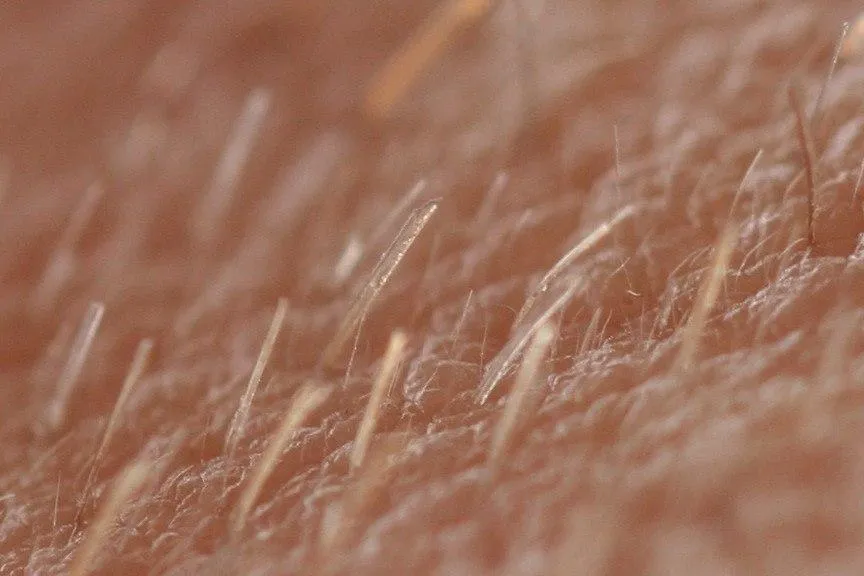
Intermediate hair sits right between the two. It’s coarser than vellus hair but not fully developed into terminal. You’ll often find it on the legs but can see it anywhere on the body including the bikini and jawline. While we are seeing this more and more in women it can appear in both men and women.
From a practitioner’s perspective, this hair can be incredibly deceptive. It’s often too clear and short to see under normal lighting, yet coarse enough that you can feel it when you glide your wrist across the skin. This is why it can feel like you’ve missed spots, even when your technique is solid. Sometimes it will feel like spots and sometimes you will notice whole strips or the entire skin area.
The challenge is that intermediate hair doesn’t always lift cleanly with sugar or wax. Because it’s in a transitional state, the follicle’s connection to the hair shaft can be inconsistent. Some hairs release easily, while others cling stubbornly, leading to that uneven, prickly texture. Its much more difficult to wax as you are limited on going over the skin. There is more success with sugaring as you can go over the skin repeatedly, however overworking is always a possibility.
But understanding intermediate growth helps you avoid overworking the skin. When you know you’re dealing with intermediate hair, you can adjust your approach, manage client expectations, and protect the skin barrier while still delivering a professional result.
Why Intermediate Hair Appears
This is where the science helps you make sense of what you’re seeing in the treatment room.10 years ago we were not seeing so much of this growth in the hair removal industry. Now that it's becoming more prevalent, it's important that hair removal practitioners understand what it is and educate their customers. No matter which removal method the customer chooses this will be an issue if they are actively growing this type of hair.
1. Partial androgen stimulation
Hair follicles respond to androgens, especially DHT, in a dose-dependent way.
Low androgen activity produces vellus hair.
Moderate activity produces intermediate hair.
Sustained or high activity produces terminal hair.
When you see intermediate hair, it’s often a sign that the follicle is responding to hormonal changes, but not strongly enough to develop into fully terminal hair. In the treatment room, this type of hair can appear anywhere on the body, though practitioners most often notice it on the legs and bikini area, where it can be more resistant to removal.
2. Local follicle sensitivity
This is one of the most misunderstood aspects. Two clients can have identical hormone levels on paper, yet completely different hair growth patterns. That’s because the difference lies in the follicle’s sensitivity, not the bloodwork.
Follicles vary in:
Androgen receptor density
5-alpha reductase activity (which converts testosterone to DHT)
Local insulin and IGF-1 signalling
This means that intermediate hair often reflects a follicle that’s sensitive, but not fully activated.
In simple terms, follicle sensitivity refers to how strongly a hair follicle reacts to hormones circulating in the body. Even if two clients have the same hormone levels, one person’s follicles might be more ‘tuned in’ to those signals. This sensitivity is partly influenced by genetics, which means some people are naturally more prone to developing thicker or darker hair in certain areas. In sugaring, this explains why some clients seem to have stubborn patches of hair that grow back faster or coarser, even when their hormone tests look normal.
3. Insulin and metabolic signalling
There’s growing evidence linking insulin resistance to intermediate hair growth. Insulin increases ovarian and adrenal androgen production, and it also amplifies androgen signalling at the follicle level. You’ll see this pattern in clients with PCOS, metabolic syndrome, or early insulin resistance, even when their lab results look “normal.”
This means a client’s General Practitioner MD might not flag anything, but their follicles are already showing early signs of metabolic imbalance. In the treatment room, these hairs often feel coarse, prickly, and more resistant to removal, especially on the legs and bikini area. Educating clients that this can be an early indicator of insulin sensitivity helps them understand it’s not about broken hair, but about what’s happening beneath the surface. Supporting them by discussing balanced nutrition, stress management, and consistent sugaring will let them know that these things can help calm the follicle response over time.
4. Time and cycling
Hair follicles need multiple growth cycles to fully convert. A follicle might produce intermediate hair for years before it becomes terminal, depending on cumulative hormonal and metabolic signalling along with genetic direction.
Practitioners often need to remove the regular growth first to uncover the true pattern of intermediate ones. These hairs can take a few appointments to remove and once removed may be back right away or take several to reappear, and because they’re dense and coarse, they can make the service times longer. It’s important to reassure clients that this isn’t regrowth from breakage, but how that follicle is growing hair. With consistent treatments, the texture and density usually improve however if they don't see improvement they will have to consider lifestyle changes
5. Regression
The process can also reverse. If androgen or insulin signalling decreases, intermediate hairs can miniaturize back toward vellus. This is why early metabolic or hormonal correction can change hair patterns.
Regression depends heavily on lifestyle factors. With consistent sugaring, these hairs can become finer and less noticeable, but if the underlying metabolic or hormonal triggers remain, they can return. This is because dormant follicles can reactivate when the body’s internal environment still supports that pattern.
Encouraging clients to explore lifestyle changes, such as reducing refined carbohydrates and learning more about metabolic health, can make a real difference. While we’re not medical professionals and can’t give medical advice, we can guide clients toward trusted educators like Dr Ben Bikman’s Metabolic Classroom or Dr Mindy Pelz, who both teach about hormone balance and nutrition on Youtube and have books on the subject. This helps clients take ownership of their results and understand that what happens on the surface often reflects what’s happening within.
Who Typically Sees This Hair
Intermediate hair used to be most commonly seen in clients with naturally lighter hair, particularly redheads. Their follicles often sit in that in-between state, which made them more prone to developing this type of growth naturally before it started to be seen more frequently.
However, in recent years, it’s become far more widespread. More and more clients are developing intermediate hair due to shifts in hormonal balance, stress, diet, and metabolic health. These changes can go unnoticed for years, sometimes even decades, before the body starts sending stronger signals that something deeper is going on.
As practitioners, recognizing these early signs gives us an opportunity to educate clients and encourage them to look at their overall wellbeing, not just the surface symptoms.
What This Means Clinically
When you encounter intermediate hair, it’s important to remember that it’s not a reflection of poor technique. It’s a biological stage that requires awareness and patience.
Because the follicle’s connection to the hair shaft is inconsistent, some hairs will release easily while others cling stubbornly. This can create that uneven, prickly texture even when your technique is solid.
The key clinical takeaway is to avoid overworking the skin. Repeated passes or excessive pressure can lead to overworking the skin if not done properly. The goal is to work smart, not hard, and to recognize when the skin has had enough.
What Practitioners Can Do to Help
The good news is that professional hair removal can absolutely help manage intermediate hair, but it’s a process, not a one-time fix.
With sugaring, you have a distinct advantage. Because sugar can grasp shorter hairs from within the follicle, it’s more effective at gradually clearing out those stubborn intermediate hairs over a series of treatments. Waxing can still help, but it typically requires the hair to be longer, so the results may take a bit more time to even out.
As a Sugarist, you should work on this hair using the Tough Hair Extraction Method taught by your Alexandria Professional Educator. (You can still learn this technique even if you learned to sugar with another company) Pay close attention to the skin during this process, as it can easily become overworked when your focus is on trying to remove those little tough hairs.
It’s also essential to discuss with your client what overworked skin looks like, as even with observation you may not see the overwork before they leave.
What overworked skin looks like
On day one, it may appear shiny, and in the days following, it can become dry and flaky. This isn’t a burn, as clients often assume, but a sign that the skin was overworked.
To treat it, use Phenomen-all which is an effective botanical formulation, used to increase skin nurturing to help repair the skin and prevent repeat overworking. This product supports healing and restores the skin barrier, allowing you to continue treatments safely and effectively.
Educating your clients about what’s happening and what to expect positions you as the expert and builds trust in your treatment room. When clients understand the process, they’re more patient, more consistent, and far more likely to stay loyal to your care.
Bringing It All Together
Intermediate hair can be one of the most challenging things you’ll face in the treatment room, but it’s also one of the best opportunities to deepen your skill and confidence as a practitioner. When you understand what’s happening beneath the surface, you can approach each client with clarity, care, and expertise.
By applying the Tough Hair Extraction Method, protecting the skin, and educating your clients every step of the way, you’re not just removing hair — you’re building trust and transforming their experience.
Keep learning, stay curious, and remember that every treatment is a chance to refine your craft and elevate your professionalism.
Shannon Gray. XX
Want to deepen your understanding of advanced sugaring techniques?
Follow @illuminate_beauty_academy for upcoming classes, workshops, and educational insights. If you have questions about mastering the Thorough Hair Extraction Method or want guidance on which course is right for you, reach out to me directly. I’ll help you find the education that best fits your goals.
And if you’re already an Alexandria Professional practitioner, you can also catch me inside the AP Sweet Talk Community where we continue these conversations and share real treatment room experiences.

